Image


Agriculture in Tonga has traditionally been a male-dominated sector, with men responsible for farming and income generation while women focused largely on household and caregiving responsibilities. Through the Joint Programme on Rural Women's Economic Empowerment (JP RWEE), however, women like Vai Finau Mafi are helping reshape these norms by taking a more active role in food production, household decision-making and community leadership.
At 63 years old, Vai Finau Mafi from Manuka has spent most of her life supporting her husband on the family farm and caring for their household of five. Although agriculture was always an important part of their lives, growing vegetables was not a regular activity, and opportunities for women to lead agricultural production were limited.
When JP RWEE was introduced in her community, she was motivated by the programme's focus on food security and women's empowerment, Finau joined other women in training sessions on vegetable production and sustainable farming practices.
Inspired by what she learned, Finau and her husband established their first vegetable garden on her parents' tax allotment land. Together with their children, they grew cabbage, lettuce, pak choi, onions and beans.
"It was beautiful," Finau recalls. "My children helped us throughout the process, and when it was time to harvest, we had more vegetables than we could use."
The harvest provided nutritious food for the family and allowed them to share fresh produce with neighbours, relatives and church leaders. Even after giving away a significant portion of their vegetables, they still had enough to sell, generating income for three consecutive months. The additional earnings helped support household expenses and enabled the family to build savings.
As JP RWEE activities expanded, more women in Manuka became involved in agricultural production. Twelve women participated in programme activities, while nine participants, including Finau, cultivated crops in a shared open-pollination area. Through collective learning and mutual support, the women strengthened both their agricultural knowledge and their confidence.
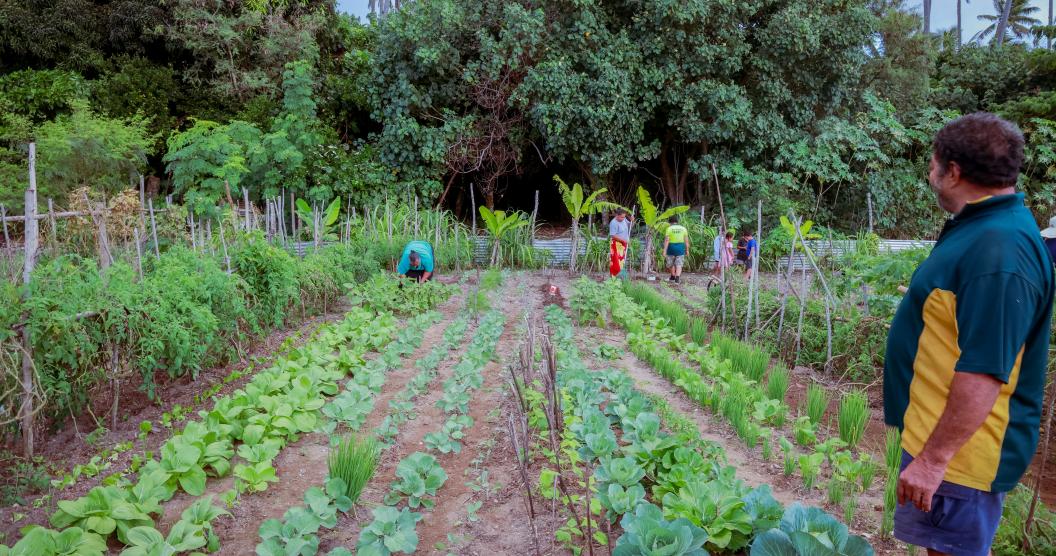
Vai Mafi during the Climate smart agriculture training on the OP site. Photo: Morgan P
Today, tending the vegetable garden is part of Finau's daily routine. The produce continues to improve her family's nutrition while also supporting vulnerable community members, including widows and neighbours in need.
The benefits have also been personal. Living with diabetes, Finau says that access to fresh vegetables has encouraged healthier eating habits and improved her wellbeing.
Like many farming communities, Manuka faces challenges. Heavy rainfall and flooding frequently damage crops in the low-lying area. Rather than facing these difficulties alone, the women worked together to protect their gardens, building fencing and strengthening infrastructure using locally available materials.
For Finau, this spirit of collaboration has been one of the programme's most important lessons.
"Working together with the women in the community is much more productive," she says. "When we support one another, we can achieve more."
Beyond improving food security and incomes, the programme has encouraged women to recognize their own abilities and take on more visible roles within the community. Finau hopes her experience will inspire other women to step forward, support their families and become leaders.
"I am grateful for this programme because it has empowered me and the women in my community to work hard, provide for our families and become leaders," she says. "We sincerely thank the donors for supporting women like us. Through this programme, we are able to put food on the table and improve our financial wellbeing, and we hope we can continue working together in the future."
Today, Vai Finau Mafi's story stands as an example of how investing in rural women can strengthen food security, improve household incomes and build stronger and more resilient communities. Through the JP RWEE, women in Manuka are not only growing vegetables—they are cultivating confidence, leadership and hope for future generations.